STEM Supplies Exclusive Product
ResistanceRace Kit
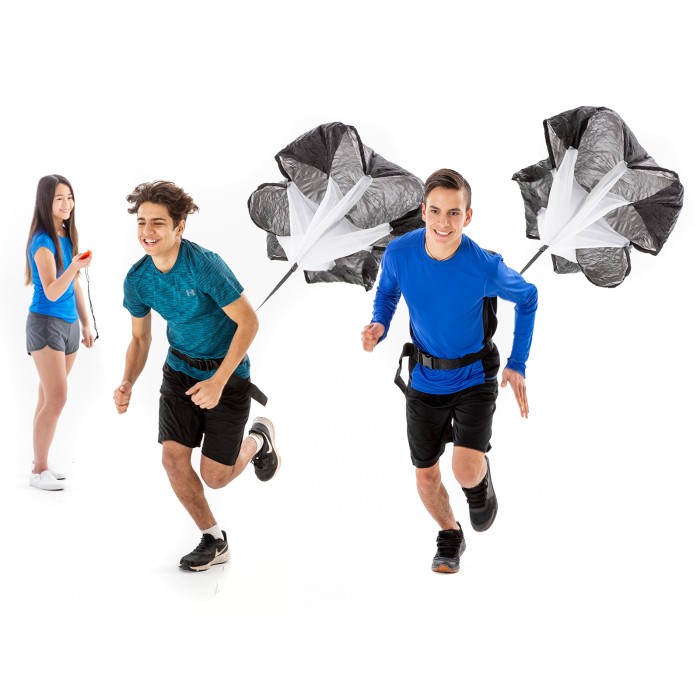
Wearing speed parachutes, students sprint to feel the force of drag and the impact that has on their motion. Students can try two different sizes of parachutes to determine how surface area impacts drag. Students work in teams to conduct experiments, record data, and analyze motion based on results.
Kit includes 2 parachutes (1 ea small, large), 3 Pacer 200TM Stopwatches, and lesson direction that is adaptable for grades 2-5 and 6-10. The included lesson direction details setup instructions, activities by grade level, learning objectives, and teaching suggestions to expand lessons. Accommodates 6 students. Recommended for Elementary and up.
For an overview of the lesson direction, click here.
Next Generation Science Standards*:
- 3-PS2-1: Plan and conduct an investigation to provide evidence of the effects of balanced and unbalanced forces on the motion of an object.
- 3-PS2-2: Make observations and/or measurements of an object’s motion to provide evidence that a pattern can be used to predict future motion.
- 4-PS3-1: Use evidence to construct an explanation relating the speed of an object to the energy of that object.
- MS-PS2-2: Plan an investigation to provide evidence that the change in an object’s motion depends on the sum of the forces on the object and the mass of the object.
- MS-PS3-1: Construct and interpret graphical displays of data to describe the relationships of kinetic energy to the mass of an object and to the speed of an object.
- MS-PS3-5: Construct, use, and present arguments to support the claim that when the motion energy of an object changes, energy is transferred to or from the object.
- HS-PS2-1: Analyze data to support the claim that Newton’s Second Law of Motion describes the mathematical relationship among the net force on a macroscopic object, its mass, and its acceleration.
- HS-PS2-2: Use mathematical representations to support the claim that the total momentum of a system of objects is conserved when there is no net force on the system.
*The Next Generation Science Standards are a registered trademark of WestEd. Neither WestEd nor the lead states and partners that developed the Next Generation Science Standards were involved in the production of this product, and do not endorse it.
Common Core Math Standards*:
- CCSS.Math.Content.3.MD.A.1: Tell and write time to the nearest minute and measure time intervals in minutes; solve word problems involving addition and subtraction of time intervals.
- CCSS.Math.Content.3.MD.B.4: Generate measurement data by measuring lengths using rulers marked with halves and fourths of an inch. Show the data by making a line plot, where the horizontal scale is marked off in appropriate units—whole numbers, halves, or quarters.
- CCSS.Math.Content.4.MD.A.1: Know relative sizes of measurement units within one system of units including km, m, cm; kg, g; lb, oz.; l, ml; hr, min, sec. Express measurements in a larger unit in terms of a smaller unit.
- CCSS.Math.Content.5.MD.A.1: Convert among different-sized standard measurement units within a given measurement system, and use these conversions in solving multi-step problems.
- CCSS.Math.Content.6.SP.B.5: Summarize numerical data sets in relation to their context.
- CCSS.Math.Content.8.F.B.4: Construct a function to model a linear relationship between two quantities.
- CCSS.Math.Content.HSF.IF.B.6: Calculate and interpret the average rate of change of a function over a specified interval.
- CCSS.Math.Content.HSG.MG.A.1: Use geometric shapes, their measures, and their properties to describe objects.
- CCSS.Math.Content.HSA.CED.A.2: Create equations in two or more variables to represent relationships between quantities.
*National Governors Association Center for Best Practices & Council of Chief State School Officers. (2010). Common Core State Standards. Washington, DC: Authors.