STEM Supplies Exclusive Product
Includes Lessons and Curriculum
MomentumMeasure Kit
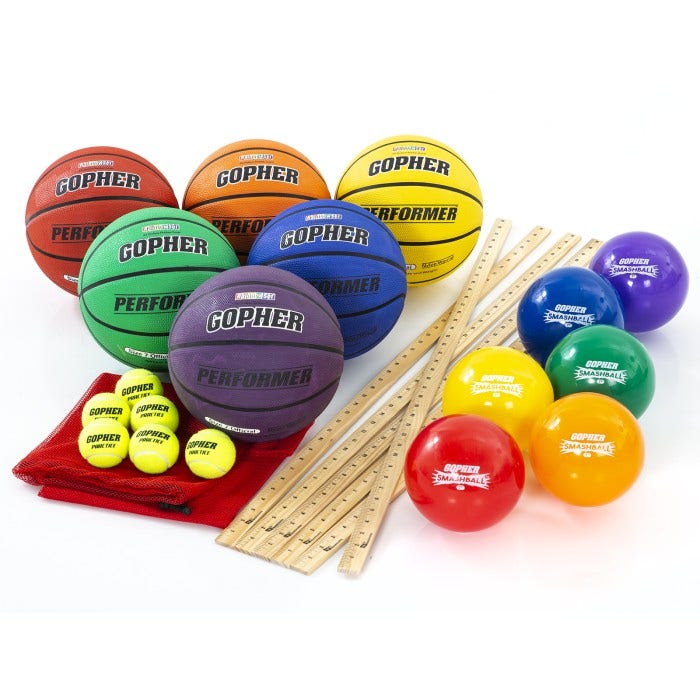
Explore and measure the momentum of differently sized balls and see how force is transferred between objects as they bounce off the ground or each other! Students collaborate in small groups of 4, including a ball holder, ball stacker, and 2 observers who watch each ball's height and collect runaways, demonstrating the value of fulfilling specific roles on a team. First, teams drop balls individually and measure the maximum bounce height of each. Then they stack all 3 balls and drop them from the same height, watching to see how the speed and height of each ball is affected. In the process, students will learn how to calculate momentum, discuss Newton's First and Third Laws of Motion, and define the Law of Conservation of Motion. They'll see how the ground acts as an outside force to disrupt a ball's motion but also pushes back against the ball, conserving momentum as the ball launches into the sky! Included lesson direction is adaptable to grade ranges K-5 and 6-12 and details setup instructions, activities by grade level, learning objectives, and teaching suggestions to expand lessons. A durable mesh storage bag makes transportation a breeze for easy setup against the perfect wall—indoors or out. 40"L x 30"W. Contents list below. Recommended for Elementary and up.
Kit includes:
- Tennis Balls, 6 Ea
- Smash Balls (7" dia), 6 Ea
- Basketballs (Size 7), 6Ea
- Yardsticks, 6 Ea
- Storage Bag, 1 Ea
- Lesson Direction, 1 Ea
For an overview of the lesson direction, click here.
Next Generation Science Standards*:
- 3-PS2-1: Plan and conduct an investigation to provide evidence of the effects of balanced and unbalanced forces on the motion of an object.
- 3-PS2-2: Make observations and/or measurements of an object’s motion to provide evidence that a pattern can be used to predict future motion.
- 4-PS3-1: Use evidence to construct an explanation relating the speed of an object to the energy of that object.
- 4-PS3-3: Ask questions and predict outcomes about the changes in energy that occur when objects collide.
- MS-PS2-1: Apply Newton’s Third Law to design a solution to a problem involving the motion of two colliding objects.
- MS-PS2-2: Plan an investigation to provide evidence that the change in an object’s motion depends on the sum of the forces on the object and the mass of the object.
- MS-PS3-1: Construct and interpret graphical displays of data to describe the relationships of kinetic energy to the mass of an object and to the speed of an object.
- MS-PS3-5: Construct, use, and present arguments to support the claim that when the kinetic energy of an object changes, energy is transferred to or from the object.
- HS-PS2-1: Analyze data to support the claim that Newton’s Second Law of Motion describes the mathematical relationship among the net force on a macroscopic object, its mass, and its acceleration.
- HS-PS2-2: Use mathematical representations to support the claim that the total momentum of a system of objects is conserved when there is no net force on the system.
- HS-PS3-2: Develop and use models to illustrate that energy at the macroscopic scale can be accounted for as a combination of energy associated with the motions of particles and energy associated with the relative positions of particles.
*The Next Generation Science Standards are a registered trademark of WestEd. Neither WestEd nor the lead states and partners that developed the Next Generation Science Standards were involved in the production of this product, and do not endorse it.
Common Core Math Standards*:
- CCSS.MATH.CONTENT.3.MD.B.4: Generate measurement data by measuring lengths using rulers marked with halves and fourths of an inch. Show the data by making a line plot.
- CCSS.MATH.CONTENT.4.MD.A.1: Know relative sizes of measurement units within one system of units including km, m, cm; kg, g; lb, oz; l, ml; hr, min, sec.
- CCSS.MATH.CONTENT.5.MD.A.1: Convert among different-sized standard measurement units within a given measurement system (e.g., convert 5 cm to 0.05 m), and use these conversions in solving multi-step, real-world problems.
- CCSS.MATH.CONTENT.6.EE.B.6: Use variables to represent numbers and write expressions.
- CCSS.MATH.CONTENT.6.EE.C.9: Use variables to represent two quantities and analyze the relationship.
- CCSS.MATH.CONTENT.7.EE.B.4: Use variables to represent quantities and construct simple equations.
- CCSS.MATH.CONTENT.8.EE.A.1–4: Work with exponents and scientific notation
- CCSS.MATH.CONTENT.8.SP.A.1–4: Investigate patterns in bivariate data.
- CCSS.MATH.CONTENT.HSA.CED.A.1: Create equations and inequalities in one variable and use them to solve problems.
- CCSS.MATH.CONTENT.HSA.REI.B.3: Solve linear equations and inequalities in one variable, including with variables on both sides.
*National Governors Association Center for Best Practices & Council of Chief State School Officers. (2010). Common Core State Standards. Washington, DC: Authors.